


Tony has nearly two decades of experience in the insurance industry and holds a Certified Insurance Counselor designation. In addition to specializing in tailored risk management for affluent families, Tony sits on Agent Advisory Boards for multiple carriers. He also gives back by teaching Personal Insurance to high school seniors.
Minnesota homeowners are getting hit from both sides. According to Insurify, the average home insurance costs in Minnesota jumped 34% in 2025, the largest increase in the nation. As if that wasn’t enough, rates then rose another 12.9% during the first half of 2026.
At the same time, many policies are replacing familiar fixed deductibles of $1,000 or $1,500 with a separate percentage-based Minnesota wind and hail deductible. A 1% deductible on a home with $500,000 in dwelling coverage can mean $5,000 out of pocket after a covered wind or hail loss.
For homeowners across the Twin Cities metro and greater Minnesota, that change can be just as important as the premium increase itself. Your annual premium tells you what it costs to carry insurance. Your deductible determines how much of a loss you may have to absorb before coverage responds.
If you’re left wondering, “Why did my home insurance deductible go up?”, the short answer is that Minnesota’s storm exposure has changed the economics of homeowners insurance. Here’s what to know before the next round of severe weather arrives.
Minnesota homeowners are paying more for storm risk
As any homeowner in the state could tell you, Minnesota has become a much more expensive state to insure. Insurify reported an average annual premium of $3,530 at the end of 2025 after the state’s 34% increase. By the end of 2026, its analysis puts the average at $3,654. In fact, five Minnesota counties experienced increases of at least 20% during the first half of 2026 alone. Hail and severe thunderstorms are a major reason. Insurify estimates nearly 1.8 million Minnesota homes, representing about $899 billion in reconstruction value, face a moderate or greater risk of hail damage. The Minnesota Department of Commerce has also pointed to increasingly costly weather events, higher repair expenses, and reinsurance costs as major pressures on homeowners insurance.
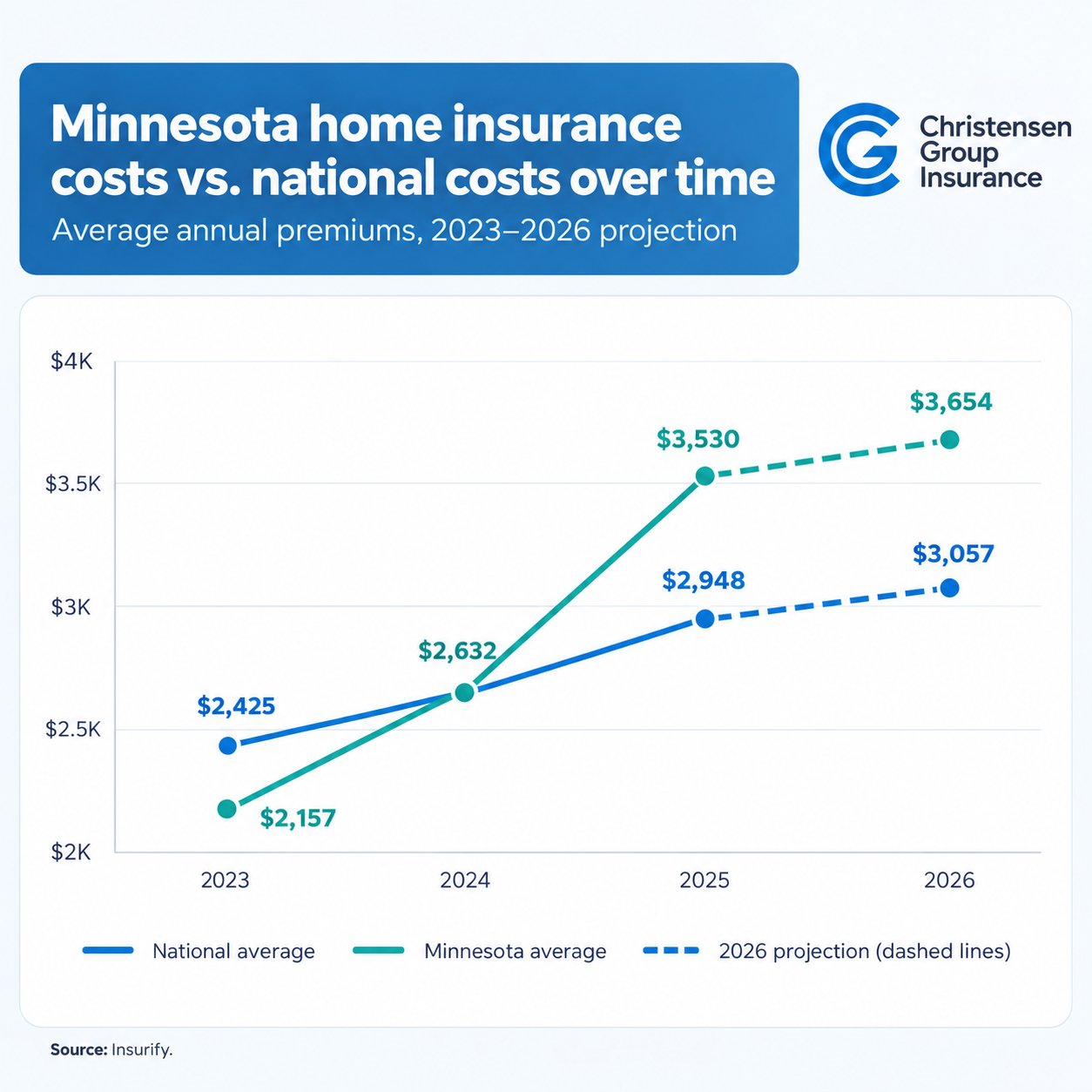
Hail and severe thunderstorms are a major reason. Insurify estimates nearly 1.8 million Minnesota homes, representing about $899 billion in reconstruction value, face a moderate or greater risk of hail damage. The Minnesota Department of Commerce has also pointed to increasingly costly weather events, higher repair expenses, and reinsurance costs as major pressures on homeowners insurance.
The Minnesota home insurance deductible increase is only part of the story, however. Carriers have also been changing what homeowners retain themselves after a storm.
For a look at why these pressures are affecting homeowners beyond Minnesota, read our overview of the broader national picture for rising home insurance rates.
Wind and hail deductible explained: Why you may have two deductibles now
Traditionally, many homeowners were accustomed to a single flat-dollar deductible. If your policy carried a $1,500 deductible and you experienced a covered $25,000 loss, you generally knew the first $1,500 was your responsibility.
That structure is changing.
Many Minnesota policies now use a separate or split deductible structure. Your policy may have:
- An all other perils (AOP) deductible, such as $1,500 or $2,500, for covered losses subject to that deductible.
- A separate windstorm and hail deductible for losses caused by wind, hail, or other specified weather events.
The second deductible may be expressed as a percentage rather than a dollar amount. The Minnesota Department of Commerce has specifically warned consumers about policies with separate wind and hail deductibles of 1%-2% or more. Industry testimony included in a 2026 Minnesota legislative task force report also described a 1% wind and hail deductible as commonplace in the current Minnesota market.
That distinction makes flat deductible vs. percentage deductible home insurance important to understand.
How a percentage wind and hail deductible works in Minnesota
A percentage deductible can look deceptively small on paper. With a fixed deductible, the number is already clear: $1,500 means $1,500.
With a percentage deductible, you need to know both the percentage and what value the policy applies it to. Many policies structure wind and hail deductibles around the home’s insured dwelling value or Coverage A amount. Your exact policy language controls, so always confirm the calculation on your declarations page or renewal notice.
Here’s a simple illustration of what common percentages can mean when applied to dwelling coverage:
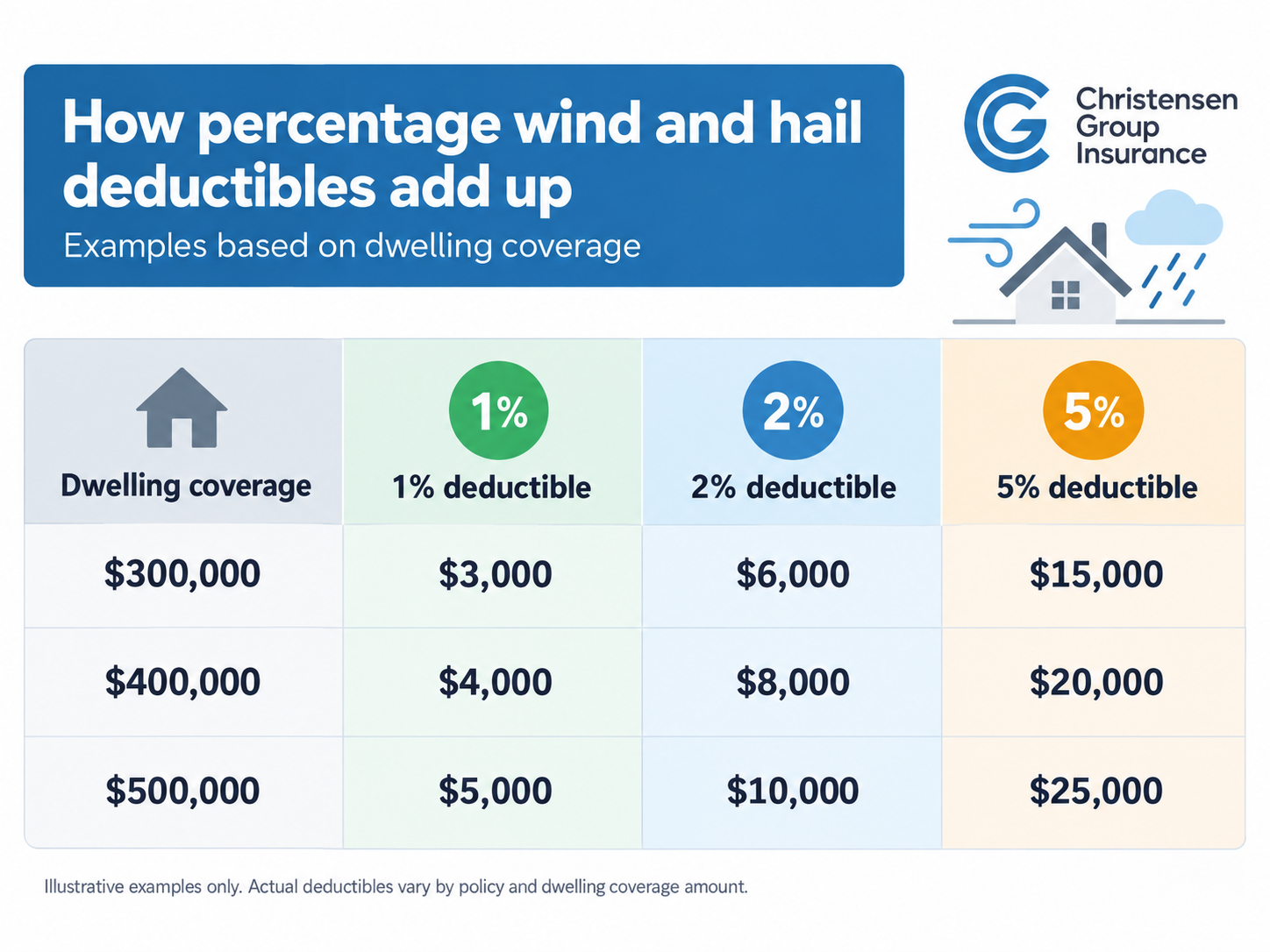
This is why a percentage wind hail deductible in Minnesota can create sticker shock. Even 1% may more than double what a homeowner previously paid under a $1,500 flat deductible.
It can also grow as your dwelling coverage increases. Coverage A is intended to reflect the cost of rebuilding your home, not its real estate market value. As labor and materials become more expensive, your insured replacement cost may rise. If your storm deductible is percentage-based, the potential dollar amount can rise along with it.
Why did my home insurance deductible go up?
The shift is fundamentally about who retains more of the risk from Minnesota’s frequent wind and hail losses.
Insurers have responded to repeated severe storm losses not only by increasing premiums, but also by increasing deductibles and tightening certain coverage terms. The Minnesota Department of Commerce reported that homeowner insurance complaints more than doubled from 569 in 2020 to 1,185 in 2023, with many involving claim denials or unexpectedly high out-of-pocket costs following wind and hail damage.
A higher Minnesota storm deductible means the homeowner retains more of smaller and moderate losses before the insurance company’s payment comes into play.
- From the insurer’s perspective, that can reduce claim costs and help manage an increasingly expensive peril.
- From the homeowner’s perspective, it means a policy with an affordable-looking premium may expose you to significantly more out-of-pocket expense.
That’s why comparing policies only by premium is becoming increasingly risky. Two quotes may look similar until you compare the wind and hail deductible, roof settlement method, cosmetic damage provisions, and other storm-related terms.
How much is my wind and hail deductible in Minnesota?
Start with your homeowners insurance declarations page and renewal documents.
Look specifically for terms such as:
- Wind and hail deductible
- Windstorm and hail deductible
- Percentage deductible
- All other perils deductible
- Coverage A or dwelling coverage
- Roof settlement terms
- Replacement cost value
- Actual cash value
Do not assume the deductible shown most prominently on the declarations page applies to every claim. Your policy could list a $2,500 AOP deductible while separately applying a much larger percentage deductible to hail.
If the language is unclear, ask your insurance agent to convert the percentage into a dollar amount for you. Knowing that you have a 2% deductible is useful. Knowing that a 2% deductible currently equals $9,200 out of pocket is much more useful.
Christensen Group’s home insurance specialists can also help review how your policy is structured and compare available personal insurance carriers.
Should I file a hail claim in Minnesota?
Not every visible dent after a storm automatically means filing a claim is the right first step.
Before submitting a claim, understand:
- What deductible applies.
- Whether there appears to be covered damage.
- The approximate cost of repairing that damage.
- Whether the policy settles affected property at replacement cost or actual cash value.
- Whether other limitations or exclusions may apply.
For example, imagine a contractor identifies $7,000 of covered hail damage, but your applicable wind/hail deductible is $6,000. The potential insurance payment may be relatively small compared with a substantially larger loss.
That doesn’t mean you should ignore legitimate damage. It means the question of “Should I file a hail claim in Minnesota?” deserves more than an automatic yes. Document the storm and damage, work with reputable professionals, review your policy, and talk with your insurance agent about the situation before deciding how to proceed.
Minnesota law also allows an insurer, under specified conditions, to refuse renewal after three or more covered lightning, wind, rain, or hail losses of more than $10,000 each during a five-year period. That makes thoughtful claim management especially important.
Can you still get a lower wind and hail deductible?
Possibly. Options vary significantly by carrier, property, location, roof characteristics, and underwriting requirements.
A flat-dollar option may be available from your current insurer or another market. In other cases, a homeowner may choose between several percentage levels in exchange for different premiums.
There are also specialty wind/hail deductible buyback products. These are supplemental policies or endorsements designed to reduce part of the deductible a homeowner would otherwise pay under the primary policy. Residential buyback products are available in parts of the market, including structures that reduce a percentage deductible to a lower percentage or fixed-dollar amount.
Availability and pricing depend on underwriting, so a wind/hail deductible buyback in Minnesota should be evaluated alongside the underlying homeowners policy rather than in isolation.
In some situations, specialty coverage may function as a standalone supplemental wind and hail policy. Your agent can help determine whether such an option is available and whether the additional premium makes financial sense given your existing deductible.
How to lower home insurance in Minnesota in 2027
Choosing the highest deductible available is not the only way to manage your premium. Consider the following options:
- Shop multiple carriers. Pricing and deductible structures can vary significantly from one insurer to another.
- Bundle policies. Combining home and auto coverage may create discounts.
- Compare your AOP and wind/hail deductibles separately. You may be comfortable retaining more risk for some losses but not a $10,000 hail deductible.
- Review your roof. Age, condition, materials, and resilience can affect underwriting and coverage options.
- Ask about protective-device and home-improvement discounts.
- Explore storm-resilient improvements. Minnesota law provides premium discounts or rate reductions for qualifying homes certified to IBHS FORTIFIED standards with a hail supplement. The state’s Strengthen Minnesota Homes program is preparing for implementation in early 2027.
- Keep dwelling coverage accurate. Reducing Coverage A merely to reduce premium or a percentage deductible can create a much larger problem if the home needs to be rebuilt.
For additional ideas, see our guide on how to reduce home insurance rates.

Know your deductible before the next storm hits
Minnesota storm season shouldn’t be the first time you discover that your $1,500 deductible became $5,000, $8,000, or more.
Reviewing your policy before a hailstorm gives you time to understand the deductible, compare alternatives, build an emergency fund for your share of a potential loss, and address other gaps in your coverage. To learn more, review our guidance on home and auto insurance coverage gaps during storm season.
Most importantly, do not shop on premium alone. The right homeowners policy is one you understand and can afford both before and after a loss. If you’re unsure how your Minnesota homeowners policy would respond after a severe storm, now is the time to review it—not after damage occurs.
Christensen Group can help you understand your current deductible, identify storm-related coverage gaps, and compare options from multiple carriers to see whether a different structure may better fit your home and budget.
Find an insurance agent or view our locations to connect with a team near you.
Frequently asked questions about Minnesota wind and hail coverage
Why did my wind and hail deductible change from a flat dollar amount to a percentage?
Insurers are using higher and separate storm deductibles to manage the increasing cost of wind and hail claims in Minnesota. A percentage deductible shifts more of the initial storm loss to the homeowner. If your insurer makes the specific percentage-deductible revision covered by Minnesota Statute 65A.29, it must provide advance notice and a flat-dollar alternative as required by the statute.
How much will I actually owe out of pocket after a hailstorm?
It depends on your policy. If your deductible is calculated as 1% of $500,000 in Coverage A, for example, that would equal $5,000. A 2% deductible would equal $10,000. Always verify the actual calculation with your policy and agent rather than relying on the percentage alone.
How do I find out what my wind and hail deductible actually is?
Check your declarations page, endorsements, and latest renewal documents. Look for a separate wind/hail or windstorm/hail deductible rather than relying only on the AOP deductible. If it is listed as a percentage, ask your agent to calculate the current dollar amount.
Is my wind and hail deductible based on my home's market value or something else?
Generally, a homeowners insurance deductible is tied to the value specified by the policy rather than what your home might sell for on the real estate market. Many percentage wind/hail structures reference dwelling coverage or replacement value. Check your specific policy because deductible language and calculations can vary.
What is a wind/hail deductible buyback, and is it worth it?
A deductible buyback is supplemental insurance intended to reduce the amount you retain under a high wind or hail deductible. Whether it’s worthwhile depends on the buyback premium, your underlying deductible, property risk, and how much out-of-pocket exposure you are comfortable retaining. Residential products exist, but availability varies.
Should I file a hail claim if the damage is close to my deductible?
Always review the situation before filing. If estimated covered damage is only slightly above the deductible, the potential claim payment may be limited. Confirm the applicable deductible, document the damage, understand your policy terms, and discuss the situation with your agent so you can make an informed decision.
.jpg)
.jpg)
.jpg)
.jpg)
.jpg)
.jpg)
.jpg)
.jpg)
.jpg)
%20(1).webp)