


Ryan Ritchey brings 17 years of experience in the insurance industry, with deep expertise in the Texas market. Originally from Pennsylvania, Ryan joined the U.S. Navy in 2000, serving nine years on active duty before settling in Texas in 2005. In 2009, he transitioned into the insurance industry, starting on the ancillary carrier side before moving to the brokerage side. His extensive knowledge and background enhance CG’s ability to provide tailored insurance solutions for Texas clients, reinforcing the company’s commitment to exceptional, locally focused service.
{{cta-contact-popup="/components/rich-text-cta"}}
Texas employers are heading into 2027 with a familiar challenge: health insurance costs continue to rise, but simply passing more cost to employees is not a long-term strategy. Higher deductibles, increased employee contributions, and leaner plan designs may reduce pressure in the short term, but they can also affect retention, morale, and overall benefits satisfaction.
According to Mercer’s 2026 National Survey of Employer-Sponsored Health Plans, employer health benefit costs are projected to rise 6.5% in 2026, the steepest increase in over a decade, driven largely by rising specialty and GLP-1 prescription drug spending.
That’s why more employers are asking better questions of their benefits broker. Instead of only asking, “What’s our renewal increase?” they’re asking, “Why are we spending what we’re spending?” and “How can we make our health plan work better for the business and our employees?”
For companies searching for how to control health insurance costs for employers, the answer often starts with a more intentional benefits strategy. That means looking beyond the renewal, understanding claims drivers, evaluating funding options, improving care access, and communicating benefits in a way employees can actually use.
This is especially important for Texas employer health insurance 2027 planning. From San Antonio and Austin to South Texas and the broader Texas group market, employers have more options than they may realize. The opportunity is not just to shop for a different carrier, but to rethink how the plan is structured, funded, and supported throughout the year.
Why Texas employer health insurance costs need a new strategy
Many employers have already used the traditional cost-control levers. They’ve raised deductibles. They’ve adjusted contributions. They’ve shifted plan designs. They’ve compared fully insured renewals year after year.
Eventually, though, that approach reaches a limit.
If the only strategy is moving more cost to employees, the plan may become less valuable to the people it’s supposed to support. Employees may delay care, struggle to understand their options, or feel like their benefits are getting worse even if the employer is still investing heavily in coverage.
That’s why employers reviewing Texas employer health insurance costs should start by looking at how the plan is actually performing. The employers making progress are moving from reactive renewal shopping to proactive plan management.
For Texas employers, the best path forward is usually not one major plan change, but a series of practical decisions that give the organization more control over how healthcare dollars are spent.
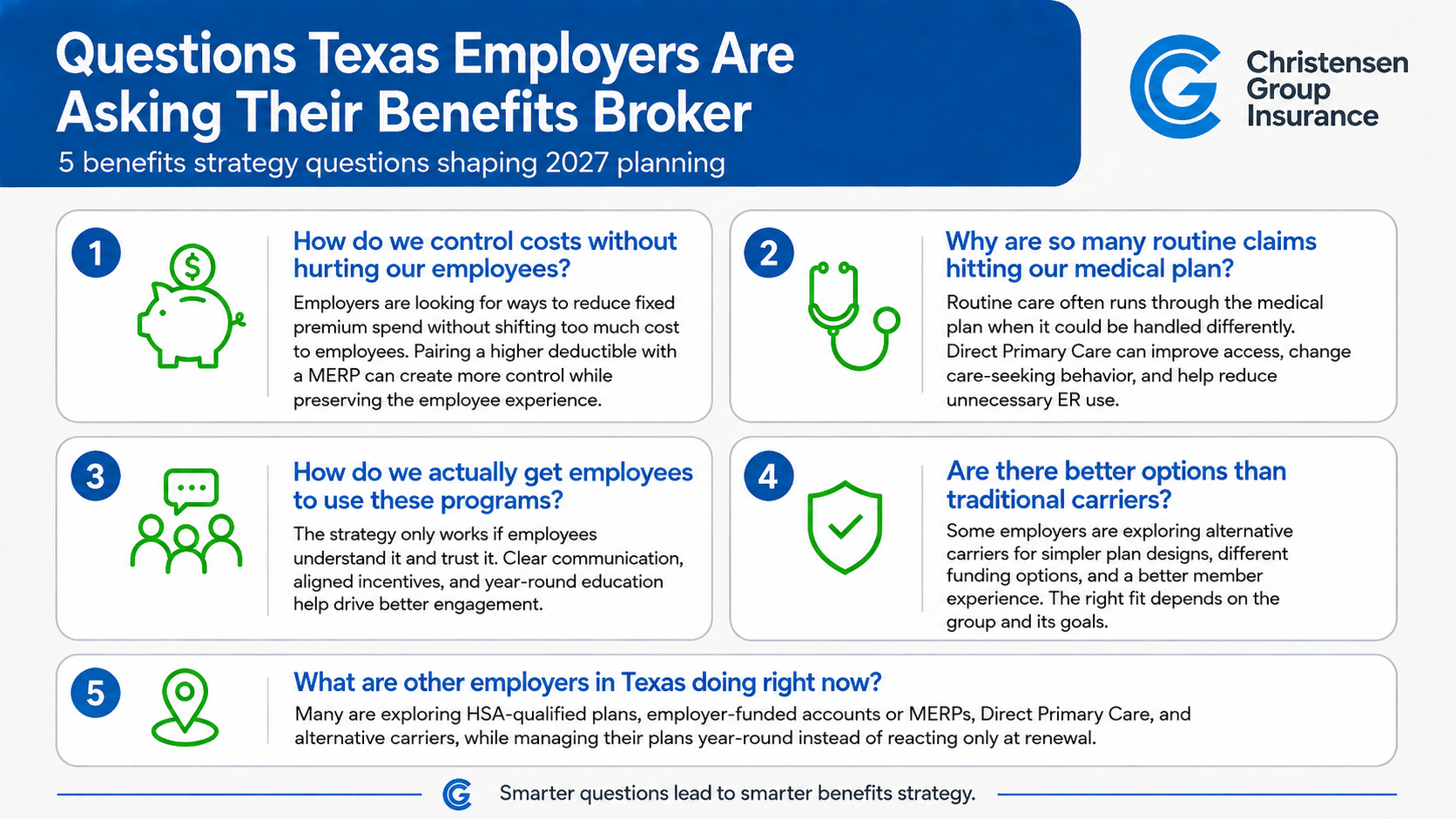
The following seven strategies can help employers evaluate their 2027 options, reduce fixed costs where possible, and build a benefits plan employees can actually understand and use.
1. Start with the data behind the renewal
A renewal tells you what the carrier is charging. Data helps explain why.
For fully insured or fully funded plans, employers may have limited access to detailed claims information, but there are still important trends to review. These may include emergency room utilization, pharmacy costs, chronic condition management, preventive care engagement, and employee participation.
For level-funded, partially self-funded, self-funded, or self-insured plans, employers may have more visibility into claims activity and plan performance. These models can provide more control and transparency, but they also require careful planning around cash flow, risk tolerance, and stop-loss insurance.
Specific stop-loss insurance can help protect against large individual claims, while aggregate stop-loss insurance can help protect against total claims exceeding expected levels. For some employers, these arrangements create more flexibility than a traditional fully insured plan. For others, the added responsibility may not be the right fit.
The key is to understand what is driving cost before making changes. A manufacturer in San Antonio, a professional services firm in Austin, and a South Texas business with a distributed workforce may all need different strategies. The right solution should follow the data.
2. Use MERPs to shift some costs from fixed to variable
One strategy gaining attention among Texas employers is the Medical Expense Reimbursement Plan, or MERP.
So, what is a MERP?
A MERP is an employer-funded reimbursement arrangement, often structured as a Section 105 plan, that reimburses employees for certain eligible medical expenses. Instead of paying higher fixed premiums to keep deductibles low, an employer may choose a higher-deductible plan and use a MERP to reimburse part of the employee’s out-of-pocket costs when claims actually occur.
For example, an employer may move from a lower-deductible plan to a higher-deductible structure, then use a MERP to cover part of that deductible. Employees may experience less disruption, while the employer shifts some spending from fixed premium costs to variable reimbursements.
This can be especially useful for employers trying to lower group health insurance Texas costs without simply cutting benefits. It may also help employers that want more control but are not ready to move into a fully self-funded arrangement.
MERPs are not one-size-fits-all. They must be designed, documented, communicated, and administered carefully. Employers should also understand how a MERP interacts with other benefits, including Health Savings Accounts.
3. Understand the difference between a MERP and an HRA
Employers often ask about the MERP vs HRA difference because both involve employer-funded reimbursements.
A Health Reimbursement Arrangement, or HRA, is a specific type of employer-funded account that reimburses eligible medical expenses under certain tax rules. A MERP is a broader reimbursement strategy that may include different plan structures, including a post-deductible MERP.
In practice, the terms can sometimes overlap, but the details matter. For example, if employees are enrolled in an HSA-qualified health plan, the employer must be careful that a MERP or HRA does not interfere with HSA eligibility. Depending on the design, a post-deductible MERP or limited-purpose HRA may be needed.
This is why employers should work with an experienced advisor before implementing a reimbursement arrangement. The goal is not only to reduce premiums. The goal is to build a compliant, understandable structure that supports both the business and employees.
4. Use direct primary care to improve access and influence claims behavior
Another strategy gaining momentum is direct primary care for employers.
Direct Primary Care, or DPC, is a membership-based care model that gives employees easier access to primary care services. Instead of waiting weeks for an appointment or using urgent care and emergency rooms for routine needs, employees may be able to access preventive care, chronic condition support, and physician guidance more easily.
DPC is not the same as concierge medicine, though the two are sometimes compared. Concierge medicine is often consumer-focused, while DPC for employers is usually designed as part of a broader group health plan strategy.
For employers, DPC can help change behavior. When employees have convenient access to primary care, they may be less likely to delay treatment or use higher-cost care settings for non-emergency issues.
Small and mid-sized employers are looking for practical ways to reduce health insurance costs for small business Texas teams while also improving the employee experience. DPC can also work alongside telehealth, virtual primary care, virtual urgent care, on-site clinic models, or near-site clinic partnerships.
5. Evaluate HSA-qualified plans carefully
HSA-qualified health plans are another common tool for employers looking to manage costs. An HSA-qualified HDHP, or high deductible health plan, allows eligible employees to contribute to a Health Savings Account. Employers may also contribute to the HSA to help offset employee costs.
The HDHP vs HSA distinction is important. The HDHP is the health plan. The HSA is the tax-advantaged account employees can use to pay eligible medical expenses. HSA contribution limits can change each year, so employers should review current limits when planning their 2027 benefits strategy. Christensen Group tracks these figures each year, most recently in our HSA and HDHP limits update.
HSA-qualified plans can work well for employees who want more control over healthcare spending, especially when paired with employer contributions, clear education, and decision-support tools. However, they may feel intimidating to employees who are used to richer first-dollar coverage.
Employers may also review other account-based benefits, such as an FSA, or Flexible Spending Account, and a dependent care FSA. These tools do not solve rising healthcare costs on their own, but they can help employees plan for predictable expenses and see more value in the overall benefits package.
6. Compare traditional and alternative carrier options in Texas
Many employers still rely on traditional carrier arrangements, and for some, that remains the right fit. Long-standing options such as Blue Cross Blue Shield of Texas (BCBSTX) continue to play a major role in the Texas health insurance market.
At the same time, employers are becoming more open to alternative health insurance carriers they may not have evaluated in the past. In the Texas group market, non-traditional options such as Curative, Evry Health, Texicare, Sana Benefits, Oxbridge Health, and others are creating more competition.
These carriers may approach plan design, funding, networks, member experience, or Direct Primary Care integration differently. Some may offer simplified plan structures or alternative models that appeal to employers looking for something beyond the traditional renewal cycle.
Alternative carriers are not automatically better, and they are not right for every business. Employers should carefully compare provider access, prescription coverage, administrative requirements, employee experience, funding model, and long-term financial risk.
Still, more competition creates more opportunities. For employers willing to evaluate new options, 2027 may be a good time to take a broader look at the market.
{{cta-benefits-general-2="/components/rich-text-cta"}}
7. Make employee engagement part of the plan design
A better plan design will not create value if employees do not understand it.
This is especially true with strategies such as MERPs, DPC, HSA-qualified plans, alternative carriers, and virtual care. Employees need to know what’s changing, why it matters, and how to make smart decisions when they need care.
The best benefits strategies make the right decision the easy decision. That may mean introducing programs during onboarding, not just open enrollment. It may mean giving employees simple examples of where to go for care. It may mean training managers to answer basic questions and directing employees to the right HR or benefits contact.
A knowledgeable Texas employee benefits broker can help employers compare plan options, model financial scenarios, communicate changes, and support employees through the transition. For local support, Christensen Group’s San Antonio employee benefits office and Austin employee benefits office can help employers evaluate market-specific strategies.
Build a better benefits strategy for 2027
There is no single solution for controlling employer health insurance costs. A company looking for South Texas business health insurance may have different needs than a fast-growing Austin employer, a San Antonio manufacturer, or a statewide organization with employees across multiple markets.
But the direction is clear. Employers that want to control costs in 2027 need to move beyond annual renewal shopping. They need to understand their data, evaluate funding models, consider reimbursement strategies, improve access to care, and communicate benefits more clearly.
Christensen Group helps employers evaluate employee benefits, group medical strategies, and long-term plan design. We can also coordinate benefits planning with broader business insurance needs, helping employers take a more complete view of cost, risk, and workforce support.
Whether you’re comparing carrier options, reviewing employer-sponsored health insurance, evaluating a MERP, or exploring Direct Primary Care, our team can help you identify what’s working, what’s not working, and what options may be available for 2027. Contact us today to get started.

Frequently asked questions about Texas employer health insurance costs
What is a MERP (Medical Expense Reimbursement Plan)?
A MERP is an employer-funded plan that reimburses employees for eligible medical expenses. Employers often use MERPs to pair a higher-deductible health plan with reimbursement support, helping reduce fixed premiums while limiting the impact on employees when claims occur.
What is Direct Primary Care (DPC) for employers?
Direct Primary Care is a membership-based primary care model that gives employees easier access to routine care, preventive care, and chronic condition support. For employers, DPC may help reduce unnecessary emergency room visits and improve employee engagement with primary care.
What is the difference between fully insured and self-funded health insurance?
In a fully insured plan, the employer pays fixed premiums to an insurance carrier, and the carrier assumes the claims risk. In a self-funded or self-insured plan, the employer pays claims more directly, often with stop-loss insurance to protect against large or unexpected claims. Level-funded and partially self-funded plans fall between these models and may offer more predictability than traditional self-funding while still giving employers more claims visibility than many fully insured plans.
What’s the difference between a MERP and an HRA?
A MERP is a broader medical reimbursement strategy, while an HRA is a specific type of employer-funded Health Reimbursement Arrangement. Both can reimburse eligible medical expenses, but plan design matters. Employers should review compliance rules, administration, and HSA eligibility before implementing either option.
Why are Texas health insurance rates increasing in 2027?
Texas employer health insurance costs can increase for several reasons, including higher claims utilization, expensive specialty medications, chronic condition management, hospital costs, provider contracts, and overall healthcare inflation. The exact drivers vary by employer, which is why claims analysis and plan review are important. Specialty and GLP-1 prescription drugs are a particularly large driver nationally, with pharmacy spending reported as one of the fastest-growing cost categories for employers heading into 2026 and 2027.
What are alternative health insurance carriers in Texas?
Alternative health insurance carriers in Texas may include newer or non-traditional options that approach plan design, funding, provider access, or member experience differently than traditional carriers. Examples may include Curative, Evry Health, Texicare, Sana Benefits, Oxbridge Health, and others. Employers should compare these options carefully against network, coverage, cost, and employee experience needs.
How can a Texas employer lower group health insurance costs without cutting benefits?
Employers can explore several strategies, including MERPs, Direct Primary Care, HSA-qualified plans, employer-funded accounts, level-funded options, alternative carriers, telehealth, virtual urgent care, better employee education, and stronger year-round plan management. The right approach depends on workforce needs, claims data, risk tolerance, and budget.
.jpg)
.jpg)
.jpg)
.jpg)
.jpg)
.jpg)
.jpg)
.jpg)
.jpg)
%20(1).webp)